The Baranovich method
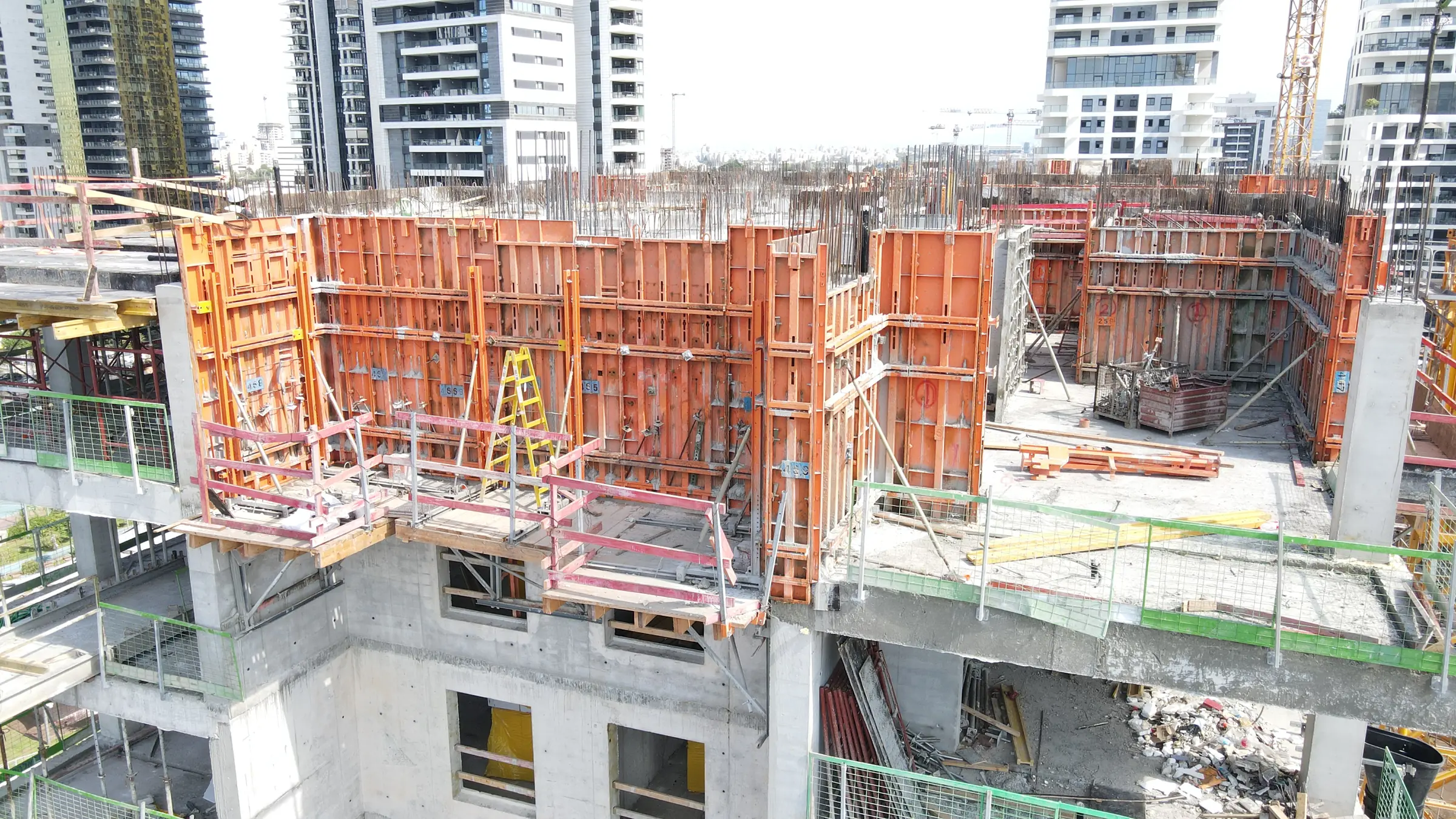
Concrete walls cast together with their stone cladding, inside steel formwork
In short
The Baranovich method (Hebrew: שיטת ברנוביץ') is an industrialized construction method widely used in Israel for residential buildings. The building's walls are cast in concrete on site inside large steel formwork panels, and the exterior cladding is cast together with the wall: the stone is placed against the outer form and anchored, and the concrete is poured behind it. When the formwork is removed, the wall is structurally complete and already clad.
The name is also written Baranovitz or Brenovitz; in Hebrew it is שיטת ברנוביץ'. Formwork made for the method is called Baranovich formwork (תבניות ברנוביץ').
How a wall is cast
- The engineering team divides the building's walls into large steel formwork panels, floor by floor, before manufacture.
- On site, the cladding (for example natural stone) is laid against the outer formwork panel and anchored.
- Reinforcement is fixed, the inner panel is closed, and the two sides are tied together.
- Concrete is poured between the panels, behind the cladding.
- After the concrete sets, the formwork is stripped. The wall is complete and already clad.
- The same set is lifted to the next floor and the cycle repeats.
HaMachresha and the Baranovich method
HaMachresha Metal Works has specialized in Baranovich formwork since 2010. Its DOR steel formwork is designed for a concrete pressure of 80 kN/m² and for an average pace of 4 floors per month, and it casts stone, porcelain, HPL and exposed concrete. The company also makes the systems around the wall formwork: balcony parapet forms that cast stone-clad parapets, perimeter scaffolding, and a ratchet system that lets the formwork climb with the scaffold instead of being lowered to the ground after every pour.
Projects built with HaMachresha Baranovich formwork
- Carasso Botanic, Jerusalem (Electra): 3 sets for 5 buildings (2 of them 30-storey towers).
- Megido TRIO, Ofakim (Megido): Precise planning for dismantling and re-assembling Baranovich formwork, to cast many low-rise buildings of different types with the same set.
- HaMeshorerim Neighborhood, Lod (El-Har): One set for 2 low-rise buildings and 2 sets for two towers.
- Plot 8, Park HaYam, Bat Yam (El-Har): Ratchet system for Baranovich formwork, based on the Kimatics scaffolding system.
- AQUA PARK — The New Quarter, Ashdod (Amram Avraham): Buildings 16, 17-18, 19-20: buildings, retail and cores.
Questions and answers
- Why do contractors in Israel use the Baranovich method?
- It joins two stages, structure and exterior cladding, into one pour. The same formwork set is lifted from floor to floor and repeats the same wall, so the work is fast and precise, the cladding is anchored into the concrete, and there is no separate stage of fixing stone to a finished facade.
- Which claddings can be cast with Baranovich formwork?
- With HaMachresha's DOR formwork: natural stone, porcelain, recesses for HPL panels, the "Kir Amir" system and exposed (fair-faced) concrete, as well as round walls, changing heights, columns and parapets.
- How fast can a building go up with Baranovich formwork?
- With correct planning and an efficient division into panels, HaMachresha plans projects for an average pace of 4 floors per month, including projects with stone cladding.
- Can Baranovich formwork be reused on another project?
- Yes. DOR steel formwork is built for many years of use and is adapted from project to project. Several HaMachresha projects were built with sets from the customer's existing stock, adjusted to the new building instead of buying or renting a new system.
- Who manufactures Baranovich formwork in Israel?
- HaMachresha Metal Works (מפעלי מתכת המחרשה), founded in 1969 and based in Ariel, has specialized in manufacturing Baranovich formwork since 2010. It designs the panel layout for each project and manufactures the formwork in its own plant.
Building in Israel?
Send us your drawings early. We will match a formwork solution to your project.